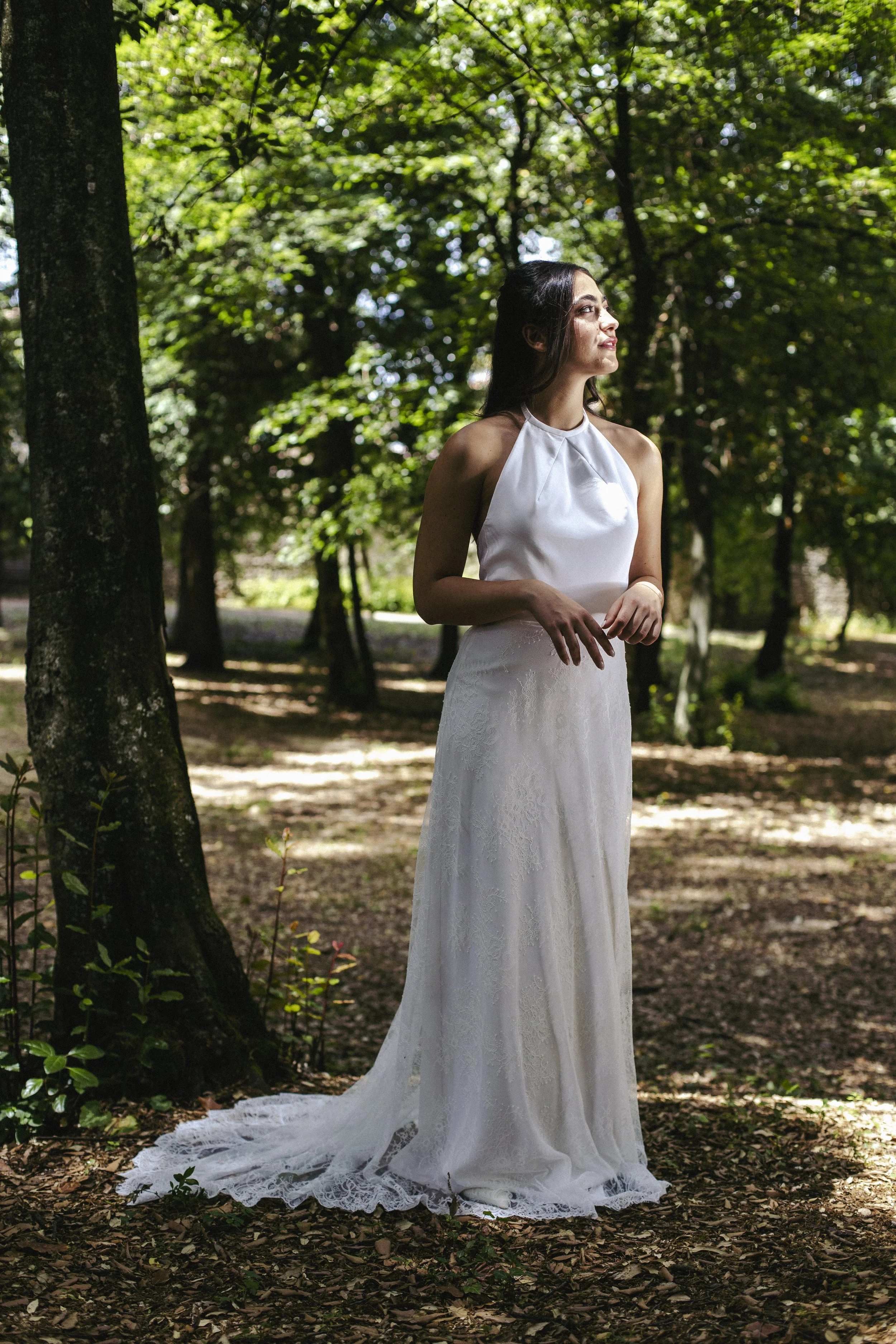
Fabric, silhouette and feeling: how to choose the right wedding dress for you
Choosing a wedding dress is one of the most anticipated — and often most stressful — moments of the journey towards marriage. Pinterest is full of beautiful images, friends all have opinions, and your head fills with ideas that sometimes contradict each other. How do you find the right dress?
The answer, in my experience, has nothing to do with your body. It has everything to do with how you want to feel.
The first questions I always ask
When I meet a bride for the first time, before even talking about fabrics or silhouettes, I ask a few fundamental questions: when is the wedding? Where will the ceremony take place — in a church, a castle, outdoors? How does she imagine the day? How does she want to feel as she walks in?
The answers tell me a great deal — often more than any Pinterest board.
Season and location matter more than you think
A winter bride has very different needs from a summer bride. Structured fabrics like mikado or silk duchesse are perfect for colder months — warm, enveloping, and majestic. Those who prefer silk in winter should also think about a cashmere wrap or a short coat — which becomes part of the look, not an afterthought.
The location says a lot about the style of the dress. A church with a long aisle almost naturally calls for a train — fixed or detachable — and often a veil. Sleeves, fixed or removable, are a practical as well as aesthetic choice for a place of worship. A castle calls for a statement skirt, perhaps enriched with layers of organza. A civil ceremony in a villa or outdoor setting lends itself to something more fluid and modern — a two-piece, a soft silhouette, something practical that allows easy movement.
Fabrics for every feeling
Silk in all its forms is thermoregulating — suitable for almost every season and almost every need. But not all silks are the same, and the choice depends greatly on how the bride wants to feel.
For those who want to feel light: chiffon, georgette and tulle are the fabrics of flight — almost weightless, romantic, beautiful paired with a light crêpe de chine or chantilly lace.
For those who want to feel majestic: embroidered lace with beading, taffeta, duchesse, mikado and organza create structure and presence. Sometimes all it takes is a dramatic train and one extra detail — a bow, an appliqué — to transform a simple dress into something unforgettable.
For those who tend to feel cold: duchesse or silk drape, with the addition of a stole, create warmth without heaviness.
For those who perspire easily: satin, though beautiful, is not always my first suggestion — there are natural silk alternatives that breathe much better and feel more comfortable throughout the day.
Silhouette is not about your body
This is perhaps the most important thing I can say. I have met brides convinced they could not wear a V-neckline because they had "too much chest" — when in fact that neckline would have been perfect for them. I have met brides in love with a mermaid skirt but deeply uncomfortable in their own skin — and in that case, insisting on the mermaid would only have added to the stress.
My job is not to convince anyone to wear something they don't want. It is to find together the alternative that makes the bride feel exactly as she wants to feel — confident, beautiful, herself. Sometimes that is an A-line skirt with godets that echo the mermaid but are kinder to the body. Sometimes it is a square neckline with small sleeves instead of a bare-shouldered bodice. Small changes that make all the difference.
For those who are self-conscious about the stomach area, a more structured fabric paired with a voluminous silhouette below the waist — which accentuates the waist and creates a visual effect that softens everything below — often works wonders. It is not about hiding, but about enhancing in the right way.
One thing I want to say to every bride
Often brides arrive at the first consultation with a fixed image in mind — taken from Pinterest, a film, a friend's wedding. And when reality does not match that image exactly, disappointment follows.
I want to say this: many of those photos are retouched, some with artificial intelligence, and certain effects simply do not exist in the real world of fabrics and real bodies. It is not your fault — it is a question of expectations.
Most of us have never worn anything close to a princess dress. It is normal not to know quite how it will feel. It is normal not to have clear ideas. Let yourself be guided, let yourself be surprised, approach it with a little lightness and playfulness — because that lightness, in the end, is what shows in the most beautiful photographs.
If you would like to begin exploring together which dress might be right for you, the first consultation with Fiordalysia is always free.